

Operational duration and incoming threat profile dictate tactical architecture, not pouch count. Stacking heavy protective armour onto every task is a direct route to rapid heat exhaustion and degraded movement. When evaluating a plate carrier vs chest rig for your tactical line, you aren't just comparing fabrics. You are balancing vital-organ coverage against endurance, heat shedding, and uninhibited mobility.
You already recognise the physical drag of poor load management. Trapped core heat drains stamina, while redundant pouches foul weapon transitions and crowd the belt line. This operational guide evaluates load-bearing capacity, metabolic strain, and harness ergonomics so you can select the exact platform your mission requires. We examine functional weight disparities, pouch distribution across front and flank zones, and modular placard integration to build a streamlined, friction-free system.
Key Takeaways
- Match your operational profile to the platform: decide the plate carrier vs chest rig question by balancing vital-torso ballistic protection against mobility and thermal venting.
- Understand structural load distribution: modern carriers use rigid cummerbunds to shift mass across the core, while chest rigs direct downward force through the shoulder harness.
- Optimise pouch geometry: prevent belt crowding and maintain a clean prone shooting profile by positioning mission essentials across front placards and flank zones.
- Prevent heat fatigue: evaluate operational duration to determine whether open-back harness airflow outweighs the thermal footprint of full torso armour carriage.
- Build a cross-compatible system: integrate modular hook-and-loop placards to run the same pouch configuration across both platforms without redundant gear purchases.
Plate Carrier vs Chest Rig: Core Structural Differences
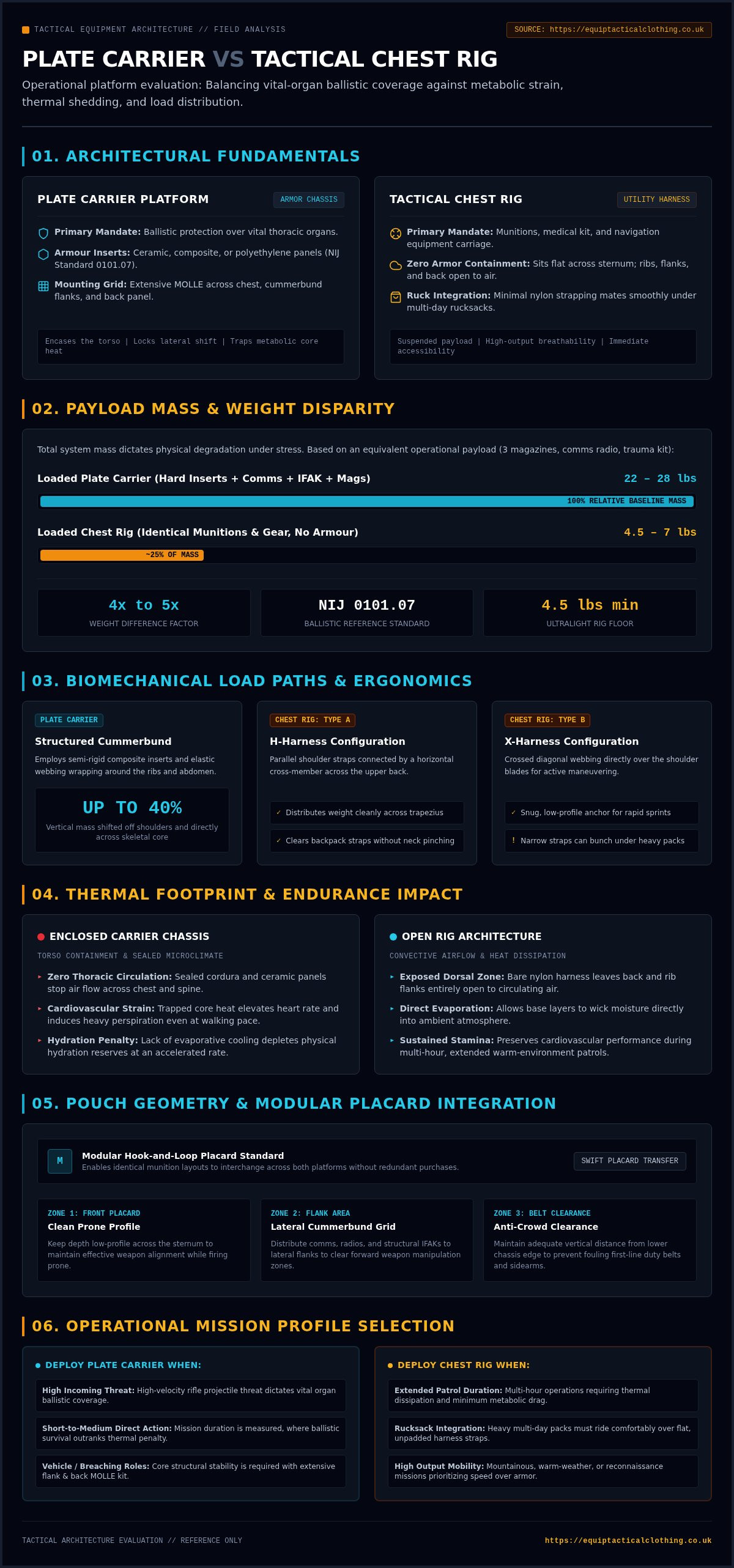
Form follows threat. The core mechanical difference between these two platforms lies in their fundamental architecture. A plate carrier is an armoured chassis built to secure rigid ballistic panels over your vital thoracic organs. A tactical chest rig is a dedicated harness platform engineered solely for munitions, medical supplies, and navigational kit. Choosing between a plate carrier vs chest rig means deciding whether your mission demands ballistic protection or maximum thermal venting and speed.
Every structural element reinforces this divide. Where an armoured carrier encases the torso to trap structural weight against the skeleton, a rig suspends utility cells directly off the shoulders. This architectural divergence dictates your endurance, heat buildup, and range of motion under load.
The Plate Carrier Platform Defined
Plate carriers employ reinforced textile pockets over the front and rear torso. These sleeves hold hard ceramic, composite, or polyethylene armour inserts designed to stop high-velocity rifle projectiles. Lateral stability comes from a dedicated cummerbund system. Modern cummerbunds wrap around the ribs using elastic, heavy nylon webbing, or semi-rigid composite inserts to lock front and rear plates firmly against the torso.
This closed structure locks down lateral shift during sprints. It also yields immense mounting capacity. Standard vests integrate extensive grids of MOLLE load-bearing equipment across the chest, cummerbund flanks, and back panel. You can mount utility items, comms radios, and structural IFAKs securely, but this total torso containment restricts air movement and accelerates core metabolic heating.
The Tactical Chest Rig Architecture
Chest rigs strip away all armour containment. The design focuses entirely on unhindered movement, high-output breathability, and instant gear access. Without heavy front and rear plate sleeves, a chest rig sits flat across the sternum, leaving your ribs, flanks, and entire back completely open to the air.
Load retention relies on a dedicated harness array:
- H-harness systems: Parallel shoulder straps linked by a horizontal cross-member. They distribute downward weight cleanly across the trapezius and clear backpack straps without neck pinching.
- X-harness configurations: Straps cross over the shoulder blades. They deliver a snug, low-profile anchor for rapid directional changes and active field sprints.
Because the back panel remains bare nylon strapping, chest rigs mate smoothly with multi-day patrol rucksacks or tuck under weather-resistant field smocks without bulk.
Load Carriage, Weight Distribution, and Ergonomics
Total payload mass dictates how your body degrades under physical stress. When running a plate carrier vs chest rig, the anatomical load paths couldn't be more different. A loaded rifle-calibre carrier configured to NIJ Standard 0101.07 ballistic standards with hard inserts, three magazines, a radio, and trauma gear typically reaches 22 to 28 lbs. An equivalent chest rig payload without armour tips the scales at just 4.5 to 7 lbs. Managing that disparity requires understanding skeletal leverage and ventilation.
Torso Fatigue and Thermal Management
Sealing cordura panels and ceramic plates directly over the thoracic cage stops air circulation cold. This creates an immediate microclimate. Core metabolic heat accumulates rapidly against the chest and spine, forcing elevated heart rates and heavy perspiration even at walking pace. Without evaporative cooling, hydration reserves deplete fast.
Chest rigs solve this by leaving your dorsal surface open. The exposed back and flank zones allow convective airflow to wick sweat directly off base layers. For extended operations in warm environments, this thermal venting preserves cardiovascular stamina far longer than any enclosed carrier chassis.
Shoulder Strain vs Torso Distribution
Carriers offset their weight penalty through superior biomechanical transfer. Modern structured cummerbunds anchor around the lower ribs and abdomen, distributing up to forty percent of vertical mass across the skeletal core rather than dangling it from the trapezius.
Chest rigs direct all downward force onto your shoulders:
- H-harness ergonomics: Wide-set vertical straps distribute weight broadly across the upper back, reducing neck pinch during multi-hour patrols.
- X-harness profiles: Crossed diagonal webbing provides secure retention during aggressive movement, but narrow straps can bunch against high jackets or pack straps.
Overloading a chest rig without rigid torso support causes shoulder nerve compression. Keep chest payloads minimal. For field practitioners balancing carriage capacity with movement speed, sourcing modular equipment from a dedicated supplier like EQUIP Tactical Clothing ensures your harness architecture matches mission requirements without redundant bulk.
Mission Profiles: Matching Platforms to Operational Demands
Operational environment and engagement distance determine platform viability. Blanket statements claiming hard armour is mandatory for every situation ignore the physical realities of field endurance. Resolving the plate carrier vs chest rig choice requires a cold assessment of terrain, operational pace, and expected contact profiles rather than habit.
Direct Action and Close-Quarters Work
Close-quarters clearance in confined spaces presents high-angle, immediate ballistic threats. Fragmentation, ricochets, and point-blank rifle fire make thoracic protection non-negotiable. Front and rear ceramic inserts covering the heart, lungs, and great vessels provide essential survivability under NIJ body armor standards.
For breachers and direct-action entry teams, structured cummerbunds also accommodate lateral side plates. These auxiliary inserts shield flank organs when clearing doorways or traversing hostile angles, where mobility takes a back seat to structural ballistic containment.
Reconnaissance, Stalking, and Extended Patrols
Distance transforms excess kilograms into a critical liability. Over twenty-kilometre movements across broken terrain, thermal exhaustion and muscular fatigue degrade cognitive awareness faster than enemy action. Chest rigs eliminate the suffocating dead-weight of ballistic plates.
Harness architecture provides substantial operational benefits across remote environments:
- Rucksack compatibility: Thin, flat shoulder straps and an empty back allow heavy sustainment packs to ride flush against your spine without binding or causing hot spots.
- Prone shooting clearance: Low-profile front cells prevent excessive chest lift, keeping your silhouette pressed tight against the turf when stalking or holding an observation post.
- Silent woodland stalking: The trimmed lateral footprint avoids catching branches, undergrowth, and boundary wire during covert field movement.
Vehicle Operations and Urban Security
Confined spaces expose the mechanical flaws of rigid armour. Thick rear ceramic plates force your spine into an unnatural forward hunch against vehicle bucket seats, inducing rapid lumbar strain during extended driver security details.
Low-bulk chest rigs sit clear of automotive bolsters, keeping essential communications, munitions, and trauma items directly on the chest for rapid seated retrieval. Modern modular rigs also feature fast-release side buckles. You can ditch the front chassis in seconds if you must egress from a rollover or extract an operative through a tight vehicle hatch.
Pouch Layout, MOLLE Real Estate, and Belt Integration
Modular real estate determines operational capability. While a carrier offers extensive surface area across three distinct planes, a rig concentrates utility onto a compact chest footprint. Resolving the plate carrier vs chest rig question requires mapping your second-line equipment so it integrates cleanly with your first-line belt, avoiding mechanical overlap and wasted motion.
Second-Line Ammunition and Medical Configurations
Ammunition carriage forms the centreline of both systems. Mount three primary rifle magazines directly across the sternum to guarantee clean, ambidextrous reloads with either hand. Never stack double-depth magazine pouches on the front panel. Stacking magazines two-deep creates excessive forward protrusion, raising your body profile off the deck and straining the cervical spine during sustained prone firing.
Trauma kit placement demands identical discipline:
- Carrier mounting: Secure an Individual First Aid Kit (IFAK) to the non-dominant flank on the cummerbund, or mount a sub-abdominal hanging pouch beneath the front flap to keep both sides open for radio cables.
- Rig utility: Use integrated wing cells flanking the magazine chassis to hold trauma shears, pressure bandages, and tourniquets where both hands can reach them under stress.
Interfacing with First-Line Tactical Belts
Equipment conflicts occur most frequently at the waistline. A heavily loaded plate carrier hangs lower than a chest rig. If your carrier plate bag extends too far down, the bottom edge slams into the rear of your duty belt every time you crouch, breaking retention and jamming sidearm draws.
Maintain a strict two-inch clearance window between the base of your front carrier plate and the top edge of your tactical belt. This space allows natural torso flexion when sprinting, taking a knee, or bending forward. Chest rigs ride naturally higher on the sternum, leaving your belt line entirely unencumbered. This higher ride height gives your dominant hand an unobstructed path to clear sidearm holsters without snagging cummerbund edges or dangling radio antennas.
Rear carrier panels easily host zip-on hydration bladders and tactical entry gear, whereas chest rig users must rely on independent hydration packs or belt-mounted utility canteens. If you need to reconfigure your second-line real estate or upgrade your load-bearing geometry, explore modular MOLLE pouches and platforms at EQUIP Tactical Clothing with same-day dispatch available on orders placed before 2 PM.
Selection Checklist: Building Your Tactical Loadout
Selecting your tactical architecture requires an honest assessment of your task envelope. Never buy gear based on aesthetic appeal or pre-set bundles built for somebody else's operating environment. Instead, follow a deliberate four-stage progression to resolve the plate carrier vs chest rig decision for your line.
- Audit threat profile: Determine whether incoming ballistic risks justify the metabolic penalty of armour. If your operational rules mandate hard torso coverage, run a plate carrier. If movement speed, long patrol distances, or sustained high heat dominate the task, deploy a chest rig.
- Calculate total payload: Tally the dry mass of your munitions, medical kit, radio hardware, and water. A payload under eight pounds functions efficiently on an unpadded harness. Exceeding twelve pounds of utility gear demands a structured cummerbund to disperse vertical mass into the pelvic core.
- Measure belt clearance: Stand upright, then drop into a full crouch. Confirm the lower edge of your chosen front platform preserves that critical two-inch buffer above your tactical belt. Check that sidearm draw corridors remain entirely clear.
- Configure modular pouches: Map your MOLLE attachments strictly by priority. Keep the primary sternum face restricted to low-profile magazine cells. Push trauma and utility elements to the non-dominant flank.
Auditing Your Operational Constraints
Operational reality often shifts between high-threat security posts and fluid field movements. Treating these platforms as mutually exclusive forces redundant spending. The modern tactical solution relies on cross-compatibility.
Adopt the swift-clip placard standard using one-inch side-release buckles spaced seven inches centre-to-centre, backed with hook-and-loop fabric. This setup lets you run one unified pouch layout. Clip the chassis into an H-harness for lightweight field patrolling. When mission parameters escalate to close-quarters work, unbuckle the harness and dock the entire loaded placard directly onto the front loop field of your plate carrier.
Procuring Field-Ready Tactical Gear in the UK
Specialist requirements demand reliable supply lines. Sourcing tactical platforms from overseas vendors introduces heavy import duties, unpredictable customs processing, and weeks of transit delay. Security professionals and operational field practitioners require immediate access to dependable kit.
Eliminate long procurement lead times by ordering through established domestic stockists. Browse the full range of EQUIP Tactical Clothing loadout gear to secure modular MOLLE pouches, plate carriers, and low-profile chest harnesses. Every domestic order placed before 2 PM qualifies for same-day dispatch, guaranteeing UK next-day delivery to keep your operational timeline on track.
Deploy the Right Tactical Platform for Your Mission
Mission success hinges on matching your load-bearing architecture to the real demands of the ground. Resolving the plate carrier vs chest rig choice isn't about finding a universal system. Armour carriers anchor your posture in direct-action environments where structural torso protection is non-negotiable. Lightweight chest rigs preserve cardiovascular stamina, unhindered agility, and vital thermal venting across long-range patrols, vehicle operations, and reconnaissance tasks.
Eliminate procurement friction and gear redundancy. Equip your loadout with field-ready platforms at EQUIP Tactical, from low-profile chest harnesses and modular plate carriers to specialized MOLLE pouches and IFAKs. Built for UK security, tactical, and outdoor operators, our inventory is field-tested and ready for deployment. Order before 2 PM to secure same-day dispatch and reliable UK next-day delivery directly to your door. Build your system with intention, maintain your physical edge, and move with confidence.
Frequently Asked Questions
Can I wear a chest rig over a slick plate carrier?
Yes, you can run a standalone chest rig directly over a low-profile slick carrier. Many modern rigs also feature detachable harnesses that dock directly onto carrier front loop fields using industry-standard swift-clip buckles. This dual-capability configuration lets you run the identical pouch setup across unarmoured patrols and armoured direct-action roles without reorganising your primary equipment.
Do plate carriers include protective ballistic plates when purchased?
No, tactical plate carriers are sold strictly as non-ballistic fabric load-bearing chassis. They feature dedicated internal sleeves to house armour inserts, but they provide zero ballistic mitigation on their own. Hard ceramic, composite, or steel ballistic plates must be acquired separately from specialized protective equipment distributors based on your required threat mitigation level.
Which loadout platform is better suited for airsoft skirmishes?
Chest rigs are generally superior for airsoft skirmishes because unarmoured speed, mobility, and heat dissipation take priority over incoming projectile mitigation. Choosing between a plate carrier vs chest rig for gaming comes down to endurance. Unless you require carrier bulk to replicate military simulations, a lightweight chest harness delivers rapid magazine indexing without trapping torso heat during aggressive sprints.
How high should a plate carrier ride on the torso?
Your front plate carrier pocket must ride high enough that the top edge aligns directly with your suprasternal notch, the soft dip at the base of your throat. This positioning places the internal plate over the heart and major thoracic blood vessels. The rear plate should mirror this height, resting roughly one inch below the prominent vertebra at the base of your neck.
Does a chest rig interfere with tactical backpacks or rucksacks?
No, chest rigs integrate with sustainment packs far cleaner than plate carriers. Because a chest rig leaves your back completely free of nylon pouches, heavy ceramic plates, or zip-on panels, large rucksack frames rest flush against your lumbar and spinal anatomy. Look for low-profile H-harness strapping to eliminate pressure points underneath heavily weighted backpack shoulder straps.
How much weight can a lightweight chest rig comfortably support?
A standard unpadded chest harness comfortably manages operational payloads between five and eight pounds. Loading past this threshold without a rigid cummerbund directs excessive downward pressure into your trapezius and shoulder nerves. If your mission payload exceeds twelve pounds of munitions, communications gear, and hydration reserves, transition to an armoured chassis to distribute that mass across your abdominal core.
Are plate carriers legal to own and wear in the UK?
Yes, it is entirely legal for UK civilians, outdoor enthusiasts, and private security practitioners to purchase, own, and train in plate carriers and chest rigs. Unarmoured nylon load-bearing platforms carry no statutory ownership bans under domestic law. Resolving the plate carrier vs chest rig question for UK training requires only matching your platform selection to your operational environment and physical conditioning goals.