

Wearing standard outdoor layers beneath a plate carrier is a direct route to operational failure. Under the crushing pressure of a combat load, conventional chest pockets, heavy seams, and buttons grind brutally against your ribcage, while dense civilian fabrics trap sweat and spike your core temperature. When sourcing tactical tops UK field practitioners, security specialists, and skirmishers demand purpose-built hybrid engineering that pairs rugged exterior sleeve protection with rapid thermoregulation across the torso.
You already know the physical toll of severe chafing during high-output movement, especially when weak sleeve fabrics shred through rough woodland or restrictive cuts bind your shoulders. Master technical fabrics, sleeve reinforcement, and body armour compatibility to select the ideal tactical top for unforgiving British conditions. We break down moisture-wicking torso knits, ripstop sleeve architecture, and sizing strategies to keep your loadout fully mission-ready for your next deployment.
Key Takeaways
- Understand why conventional seams fail beneath heavy armour and how dual-fabric combat shirts eliminate pressure bruising.
- Balance active moisture management with high-abrasion woodland protection when choosing tactical tops UK operators deploy in variable climates.
- Select the exact garment architecture for your operational profile, choosing between high-output combat shirts, low-profile duty polos, and weather-resistant smocks.
- Master field maintenance protocols, including mating hook-and-loop fasteners before low-temperature laundering, to preserve fabric performance and garment service life.
Operational Demands: Why Standard Shirts Fail Under Tactical Loadouts
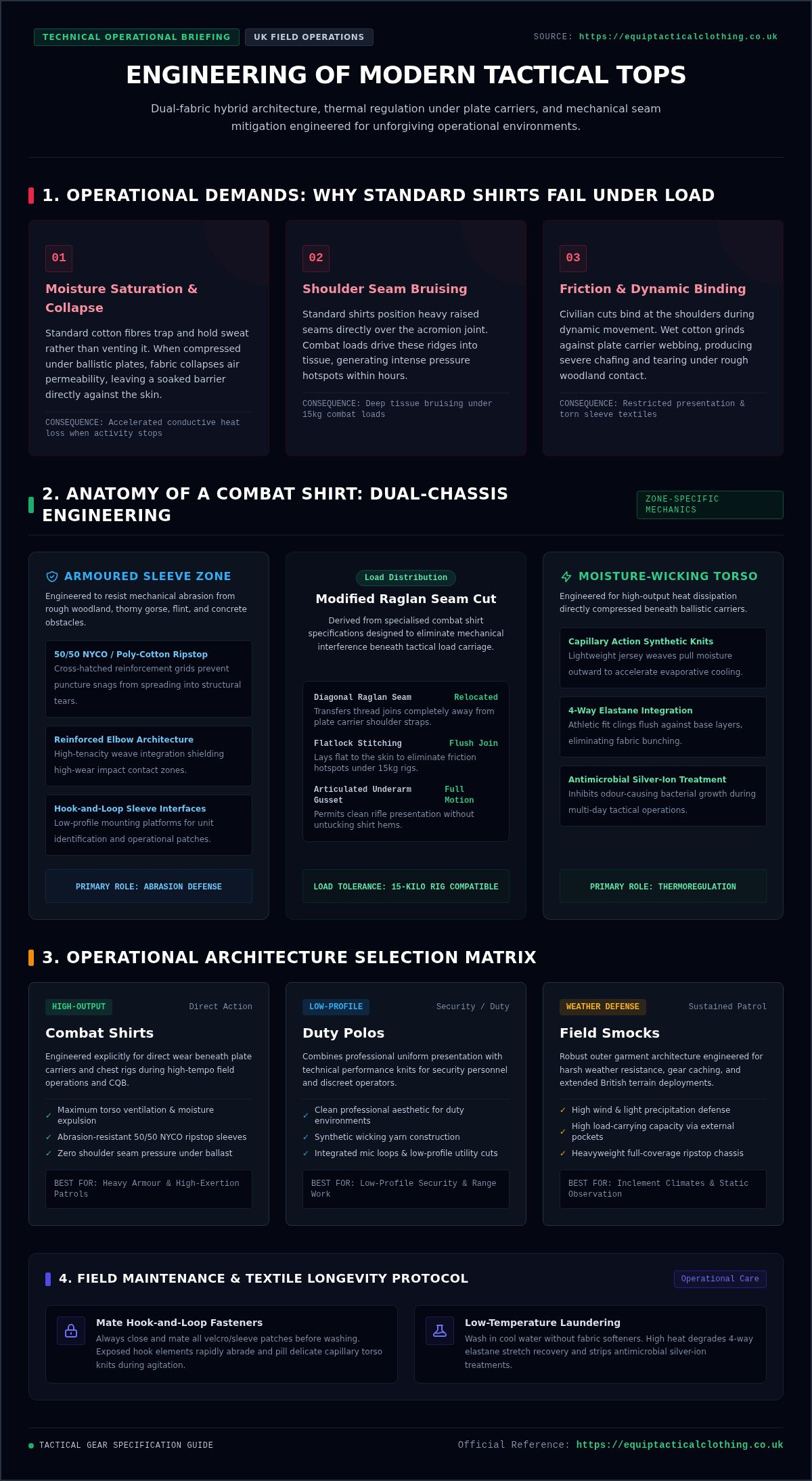
Standard field utility shirts and civilian cotton tees fail rapidly under mission loads. When compressed beneath a plate carrier or chest rig, conventional garments cause severe mechanical friction, trap moisture, and restrict dynamic movement. Purpose-built tactical tops establish a dual-zone system engineered specifically for high-mobility, load-bearing operational profiles. They isolate high-abrasion zones on the limbs while deploying active moisture-management knits across the chest and back.
For operators sourcing dependable tactical tops UK supply chains must deliver equipment built around modern load carriage rather than outdated uniform conventions. Without specialised construction, standard clothing breaks down at load-bearing contact points, causing painful hotspots that degrade focus and field performance.
The Problem with Heavy Cotton Under Body Armour
Cotton fibres hold moisture rather than venting it. When non-wicking cotton is compressed by ballast or ballistic plates, sweat cannot evaporate. The textile becomes saturated, collapsing air permeability entirely. This waterlogged barrier sits directly against the skin, causing severe friction abrasions as abrasive outer plate carrier webbing grinds over the wet fabric during high-tempo movement.
In unpredictable British weather, soaked fabric presents another operational hazard. During dynamic patrols, operators overheat; the moment activity stops, that trapped water accelerates conductive heat loss. This rapid cooling leaves you shivering in the field. Technical apparel prevents this vulnerability by pairing synthetic capillary yarns with open-weave architecture.
Load Distribution and Seam Relocation
Conventional shirts position heavy, raised seams directly across the crest of the shoulder. Seat a plate carrier loaded with ceramic plates and ammunition on top of that raised seam, and downward pressure drives the stitched ridge into the acromion joint. Within hours, that concentrated pressure produces bruising and deep tissue soreness.
Modern combat shirts resolve this through modified raglan sleeve configurations. Originating with the specialised Army Combat Shirt design developed to support modern body armour systems, these garments relocate critical seam lines entirely away from shoulder strap contact zones. Flatlock stitching lays completely flush against the skin, preventing pressure hotspots beneath chest harnesses, plate carriers, and heavy patrol packs.
- Eliminated Shoulder Seams: Diagonal raglan cuts transfer friction points away from rig straps.
- Flatlock Seaming: Low-profile thread joins prevent pressure bruising under 15-kilo combat loads.
- Articulated Range of Motion: Patterned underarm gussets ensure clean rifle presentation without pulling the shirt out of your trousers.
- Abrasion Shields: Reinforced elbows and high-tenacity sleeve weaves resist jagged obstacles in rough woodland or urban structures.
Anatomy of a Tactical Top: Torso Fabrics and Armoured Sleeves
A tactical top is not a uniform piece of clothing. It is an engineered hybrid uniting two entirely different textile behaviours into a single operational chassis. Standard field shirts use a single woven fabric throughout. In contrast, modern combat shirts pair an ultra-breathable, moisture-wicking torso with heavy-duty, abrasion-resistant sleeves. This deliberate architecture protects exposed extremities while regulating core body temperature beneath heavy ballistic gear.
When selecting professional tactical tops UK operators evaluate these distinct zones separately to guarantee proper balance between environmental protection and internal heat dissipation.
Torso Engineering: Core Thermal Regulation
The torso section prioritises active moisture management and high stretch. Constructed from lightweight synthetic knits, polyester-cotton blends, or technical jersey weaves, it pulls sweat outward via capillary action to accelerate evaporative cooling. Integrating four-way elastane gives the torso an athletic fit that clings flush against your base layers without excess fabric bunching. Silver-ion or antimicrobial treatments prevent odour-causing bacterial colonisation during continuous, multi-day operations.
Sleeve Architecture: Ripstop Reinforcement and Articulation
Sleeves face heavy mechanical threats: flint, thorny gorse, concrete walls, and sharp brush. To counter these hazards, manufacturers construct sleeves from 50/50 NYCO (nylon-cotton) or poly-cotton ripstop. These cross-hatched reinforcement grids prevent puncture snags from evolving into long, structural tears.
Key sleeve engineering elements include:
- Internal Pad Pockets: Ergonomic elbow compartments tailored for removable closed-cell foam inserts to absorb dynamic ground impact.
- Articulated Elbow Panels: Pre-curved fabric patterns that eliminate binding when holding a low ready or cheek weld.
- Hook-and-Loop Cuff Tabs: Adjustable wrist closures that seal tight against grit, cold drafts, and foliage debris.
Tactical Utility Features: Pockets and Loop Fields
Once you secure a plate carrier or load-bearing harness, traditional chest pockets become completely inaccessible. Combat shirts adapt by shifting functional utility to the upper arms. Angled bicep pockets with low-profile zip or flap closures provide fast access to compasses, notebooks, and tactical medical gear without interference from your rig.
External loop fields sewn over these pockets allow operators to mount team identifiers, IFF markers, and blood group patches securely. Around the neck, a low-profile mandarin collar with a quarter-length zip shields the skin against abrasive weapon slings and plate carrier yokes. Unzip it during forced marches to vent heat rapidly, then seal it up to block wind and airborne debris.
Match your operational requirements by sourcing the correct chassis. Explore the field-ready selection available at EQUIP Tactical Clothing to pair durable sleeve architecture with high-efficiency core ventilation.
Combat Shirts vs Tactical Polos vs Field Smocks: Selection Matrix
Operational success begins with selecting the correct silhouette for your profile. Deploying the wrong garment compromises thermal regulation and mission efficiency. When evaluating tactical tops UK operators generally choose between three distinct chassis: hybrid combat shirts, tactical duty polos, and traditional field smocks. Each serves a distinct load profile and visibility mandate.
| Garment Chassis | Primary Loadout Integration | Core Strengths | Operational Limits |
|---|---|---|---|
| Combat Shirt | Plate carriers and chest rigs | Active cooling; reinforced sleeves | Unprotected torso if worn slick |
| Tactical Polo | Concealed carry and duty belts | Low-profile; integrated mic loops | Zero heavy brush defence |
| Field Smock | Stand-alone webbing or rucksacks | Wind resistance; maximum carriage | Bulky beneath ballistic armour |
Combat Shirts: Built for Overt Armour Integration
Combat shirts are the standard for overt direct-action, skirmish events, and live-fire range drills. They excel under continuous plate carrier wear. Synthetic torso knits vent steam while ripstop sleeves protect against debris. Do not wear them slick without armour. Without a vest covering the lightweight torso knit, exposed chest fabrics snag and pill against dense brush and thorn bushes.
Tactical Polos: Professional Low-Profile Duty
Close protection officers, armed police trainers, and private security teams demand covert utility. Tactical polos bridge that gap. Built from heavy-duty piqué knits or stretch synthetics, they resist wrinkling over long shifts. Discreet features include concealed pen tubes on the sleeve, hidden sunglass tabs, and reinforced shoulder loops for radio microphones. They maintain a sharp appearance without telegraphing an aggressive tactical footprint.
Button-Down Field Shirts and Smocks: External Durability
Traditional button-down field shirts and combat smocks provide comprehensive outer-layer defence for rural reconnaissance and perimeter patrols. Constructed entirely from full-torso 50/50 NYCO or poly-cotton ripstop, they shrug off biting brambles, barbed wire, and abrasive soil. Unlike light combat shirts weighing under 500 grams, an unlined field smock weighs roughly 1,000 to 1,250 grams to block Atlantic wind gusts and provide deep bellowed pocket storage across the torso.
Never layer a heavy smock beneath a snug plate carrier. Bulk fabric and raised buttons will press into your ribs. Reserve combat shirts for body armour systems, polos for urban assignments, and field smocks for cold, open patrol terrain.
How to Choose the Right Tactical Top for UK Climate and Loadouts
Selecting operational gear requires a systematic audit. Buying on appearance leads to field failure. When procuring tactical tops UK practitioners must balance five key factors to ensure seamless integration with their protective kit, ambient terrain, and mission schedule.
- Audit Primary Load Carriage: Match your shirt directly to plate carrier, chest harness, or belt setups.
- Select Purposeful Colourways: Establish visual concealment tailored to UK operational environments.
- Dial in Compression Sizing: Eliminate loose folds that create painful ridges beneath armour.
- Assess Joint Protection: Confirm sleeve pockets accommodate flexible elbow inserts.
- Secure Rapid Domestic Delivery: Avoid overseas shipping delays ahead of mission timelines.
Step 1 & 2: Loadout Matching and Colourway Discipline
Start with your loadout. If you deploy a heavy plate carrier with ceramic inserts, run a dedicated combat shirt. The high-ventilation torso chassis prevents sweat-soaking beneath the vest. If your primary platform is a lightweight chest harness over an exposed torso, choose a full ripstop field shirt to protect against briars and low branches.
Next, lock down colourways. UK temperate woodlands demand Multi-Terrain Pattern, classic woodland variants, or Ranger Green to disrupt your visual silhouette against damp greenery. Urban security operations, low-profile training, and maritime roles benefit from solid Wolf Grey, Coyote Tan, or utilitarian Black. Maintain strict shade consistency across your combat trousers, plate carriers, and tactical tops to ensure uniform visual discipline.
Step 3: Sizing for Compression Without Restriction
Standard civilian shirt sizing does not work under body armour. Sizing up creates excess torso fabric. Under the weight of a compressed vest, that extra material wrinkles into thick cloth ridges, cutting into your ribs. Choose a snug, athletic fit across the torso so the fabric sits smooth against your skin.
Check sleeve lengths at full arm extension. When punching out into a high ready position or crawling across wet gravel, the cuffs must remain seated firmly at the wrists without yanking the torso fabric upward. If operating in freezing winter conditions, allow just enough clearance beneath the torso for an ultra-thin merino or synthetic technical thermal layer.
Step 4 & 5: Protective Inserts and Fast UK Delivery
Tactical mobility demands low-profile impact absorption. Verify that elbow compartments feature internal retention tabs or envelope flaps to keep closed-cell foam pads securely seated over your joints during aggressive dynamic drills.
Finally, protect your preparation timeline. Ordering from international distributors exposes your gear to customs bottlenecks and extended logistics lag. Source directly from domestic suppliers to secure dependable logistics. Gear up for your next operational deployment; Browse tactical tops at EQUIP Tactical Clothing with fast UK next-day delivery on orders placed before 2 PM.
Equipping Your Tactical Rig: Field Integration and Gear Care
Technical hybrid clothing demands disciplined maintenance. Saturated mud, salt crust from perspiration, and ground grit quickly grind down technical yarns. Without proper laundering, the high-performance fabrics in combat shirts degrade, losing their elasticity and wicking efficiency. When deploying tactical tops UK operators rely on strict care protocols to preserve garment lifespan and maintain operational readiness.
Laundering and Maintaining Technical Hybrid Tops
Washing hybrid tops requires attention to detail. The most common cause of premature wear happens inside the washing machine drum. Exposed hook-and-loop fasteners act like wire brushes against delicate synthetic knits, pulling threads and shredding the torso fabric. Fasten all wrist tabs, bicep pocket flaps, and patch fields completely before washing. Turn the entire top inside-out to shield the outer face.
- Low Temperature Cycles: Wash at 30°C to 40°C on a gentle cycle. Excessive heat damages bonded elastane fibres and shrinks torso hems.
- Non-Biological Detergent: Use pure liquid detergents free from optical brighteners. Brighteners coat technical yarns, altering light reflection and degrading specialised finishes.
- Zero Fabric Softeners: Avoid fabric conditioners entirely. Softeners deposit chemical waxes that clog the microscopic capillary channels required for moisture transfer.
- Line Dry Only: Hang garments to dry naturally away from radiators or open flames. Tumble dryers break down synthetic stretch retention.
Completing Your Operational Clothing Setup
A tactical top does not function in isolation. It forms the foundation of your complete combat uniform. Pair your upper layer with reinforced tactical trousers constructed from matching ripstop fabrics to maintain balanced abrasion resistance from head to ankle. Ensure your waistline sits comfortably beneath duty belts without pinching the lower torso fabric.
Integrate your apparel with modular plate carriers, chest rigs, and mission-essential pouches. A properly fitted top creates a clean, friction-free interface beneath your load-bearing equipment, keeping plates stable during hard sprints and tactical transitions.
When training dates and field exercises approach, delivery speed matters. Avoid extended shipping delays and import fees from international retailers. Lock in dependable operational gear with fast UK domestic dispatch. Gear up at EQUIP Tactical Clothing to access full field apparel inventories, backed by rapid next-day delivery on orders completed before the 2 PM cut-off.
Equip Your Rig for Maximum Operational Performance
Your base layer dictates your physical endurance under heavy kit. Running civilian cotton shirts or poorly fitted garments beneath armour compromises mobility and causes severe friction injuries. True mission readiness requires purpose-built engineering: high-ventilation torso knits that vent trapped body heat, paired with reinforced ripstop sleeves designed to withstand dense British brush. Dialling in an athletic fit eliminates fabric bunching under plate carriers, ensuring unrestricted weapons handling and lasting comfort in the field.
When selecting professional tactical tops UK operators, skirmishers, and private security teams trust specialised gear designed for demanding field profiles. Complete your tactical setup with inventory bridging field apparel, modular plate carriers, and chest rigs built for immediate operational integration. Protect your deployment timeline and eliminate logistics lag. Order field-ready tactical tops with UK next-day delivery at EQUIP Tactical Clothing on orders placed before the 2 PM cut-off, and step into your next operation fully prepared.
Frequently Asked Questions
What is the main difference between a combat shirt and a standard tactical top?
A combat shirt features a dual-fabric construction specifically engineered for wear under body armour, whereas standard tactical tops use uniform fabrics throughout. Combat shirts pair a lightweight, moisture-wicking torso knit with heavy-duty ripstop fabric across the sleeves and shoulders. Standard options, such as tactical duty polos or traditional field shirts, use consistent woven or piqué material across the entire body, delivering balanced durability for everyday operational tasks.
Can I wear a tactical top without a plate carrier or body armour vest?
Yes, but doing so exposes the lightweight torso fabric to increased surface abrasion and environmental damage. The torso knit of a combat shirt is engineered specifically for breathability beneath load-bearing kit, not rough brush protection. Walking through dense woodland without a vest or rig can cause fabric snagging and pilling. For standalone wear, traditional ripstop field shirts or tactical polos offer far better all-around protection.
How tight should a tactical combat shirt fit across the chest and arms?
A combat shirt should fit snugly against your torso like an athletic base layer, while leaving sufficient room in the sleeves for dynamic movement. When shopping for tactical tops UK operators should avoid loose torso cuts that fold and pinch beneath plate carriers. The torso must sit flat to pull sweat away from the skin, while sleeves must remain articulated to prevent cuff binding.
Are tactical tops suitable for the UK climate during wet and cold months?
Tactical tops perform effectively in wet and cold UK weather only when integrated into a disciplined layering system. The high-permeability torso knit vents sweat during intense movement, but it lets cold wind cut straight through when stationary. In damp British environments, wear an ultra-thin technical thermal base layer underneath, and keep a windproof field smock or packable softshell accessible to throw over your rig during halts.
Can I insert elbow pads into standard tactical tops?
Most field-ready combat shirts include integrated elbow pad compartments designed to house low-profile protective inserts. These pockets usually feature internal hook-and-loop retention or envelope folds that secure flexible closed-cell foam padding directly over the joint. Standard tactical polos and utility shirts lack these compartments, requiring standalone external hard-shell elbow pads if your tactical role demands heavy ground contact during prone drills.
What is the best way to clean tactical tops to preserve the fabric?
Wash your top inside-out at 30°C to 40°C with all hook-and-loop fasteners securely closed. Fastening sleeve tabs and pocket patches prevents exposed micro-hooks from snagging and shredding the delicate torso knit. Use non-biological liquid detergent free from optical brighteners to protect fabric treatments. Never use fabric softeners; they clog capillary moisture-wicking pores. Finally, line dry the garment naturally to preserve synthetic elastane stretch.
How fast can I receive tactical tops in the UK for urgent deployments?
You can receive tactical apparel the next working day when ordering through domestic UK suppliers like EQUIP Tactical Clothing. For time-critical field exercises, kit preparation, or upcoming skirmish weekends, orders completed before the 2 PM cut-off qualify for rapid next-day dispatch. Sourcing your tactical tops UK kit domestically eliminates international customs bottlenecks, unnecessary delays, and expensive import surcharges, keeping your operational timeline on schedule.